


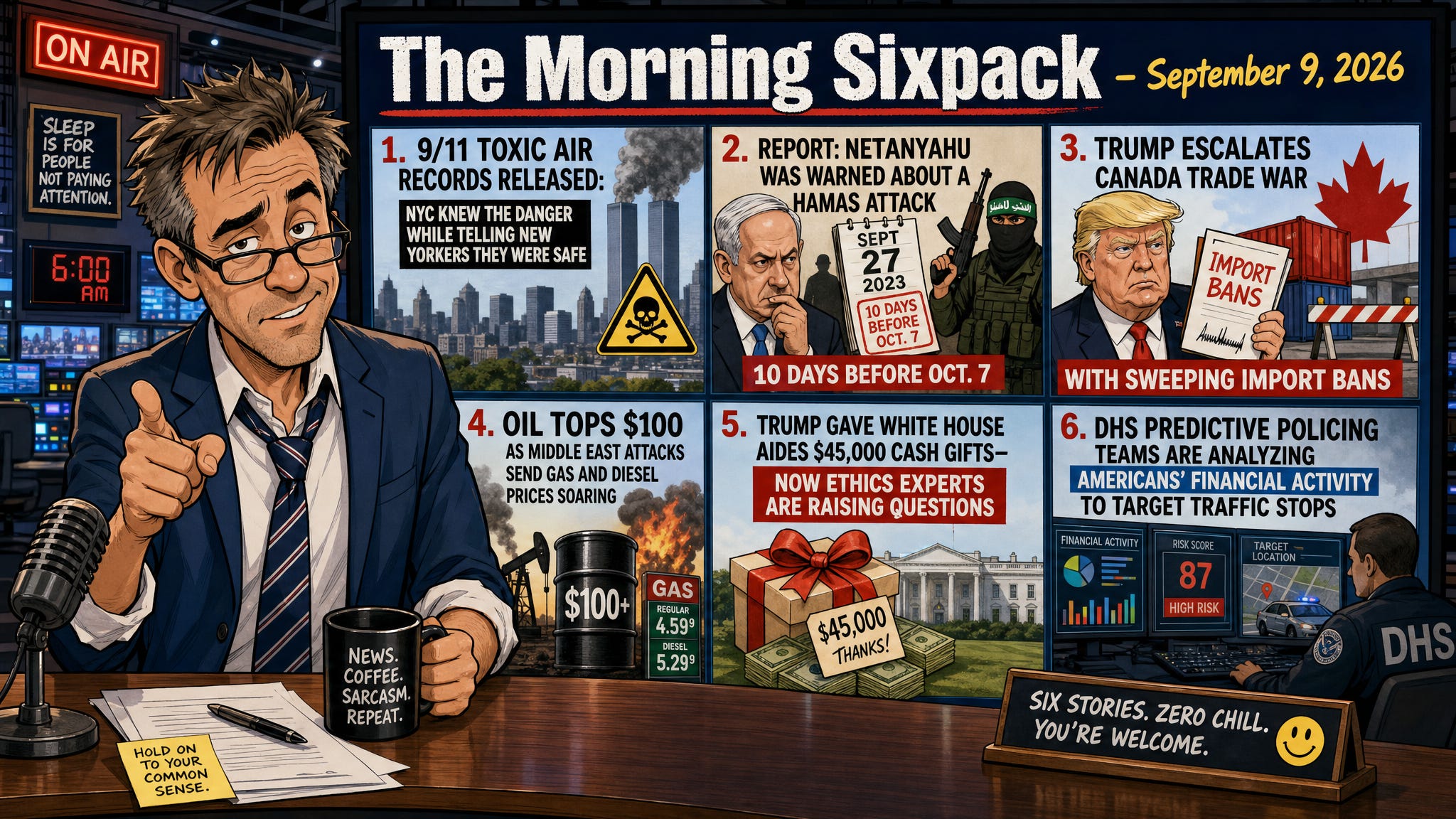
The Morning Sixpack stays free because the news that shapes your life should not be hidden behind a paywall. Paid subscribers are not paying for access. They are helping fund the research, writing, and independent voice that goes into every issue. Become a paid subscriber and help keep smart, honest news analysis free for everyone.
New York City just released 170,000 pages showing officials worried about toxic exposure and lawsuits after 9/11 while the public kept hearing the air was safe—nothing says public health quite like checking the liability exposure first.
9/11 Toxic Air Records Released: NYC Knew the Danger While Telling New Yorkers They Were Safe
Just days before the 25th anniversary of 9/11, New York City released 170,000 pages of records revealing officials were privately discussing toxic exposure, asbestos, and potential lawsuits while residents and workers were being reassured about the air around Ground Zero.
For thousands of first responders, workers, and Lower Manhattan residents who later became sick, these documents put some very ugly government conversations in black and white. Mayor Zohran Mamdani said the records provide “accountability around city government’s response to September 11 that New Yorkers have been denied for years.”
His assessment was considerably less bureaucratic a few moments later: “People got sick because the leaders they trusted lied and told them they were safe to breathe in toxic air.”
Among the documents is the October 2001 “Harding Memo,” which warned then-Deputy Mayor Robert Harding that New York City could face as many as 10,000 lawsuits involving “toxic exposure” and faulty safety equipment. Another 2002 memo acknowledged “at least a low level of asbestos in the dust in many buildings in lower Manhattan” while discussing criticism that potentially damaging asbestos findings had been suppressed. Former Giuliani adviser Ester Fuchs even wrote, “At the least, we should discontinue telling people to clean their apartments with wet mops and rags.” That is one hell of a sentence to discover 25 years later.
The records were released following years of litigation by 9/11 Health Watch and other advocates seeking information about what officials knew after the attacks. Mamdani says additional disclosures could eventually total millions of pages.
Jon Stewart, who has spent years advocating for 9/11 responders and survivors, put the issue plainly: “But I guarantee you it would not have been the struggle that it was to get people to recognize that what they all knew and what we all knew who live in downtown Manhattan: That there was poison in the air and on the ground.”
The human toll makes the paper trail far more than an exercise in historical accountability. Nearly 3,000 people were killed in the September 11 attacks, and thousands more have since died from related illnesses; the World Trade Center Health Program puts the number of subsequent deaths cited in the report at roughly 4,343, while the CDC estimates about 400,000 people were exposed to toxic contaminants, dangerous conditions, or risks of physical injury. Mamdani called releasing the documents “the right thing to do,” and Stewart stressed that the fight isn’t finished: “There’s more work to be done.” Twenty-five years later, “never forget” apparently also requires making damn sure the government doesn’t get to forget what it knew.
Editor: Officials were apparently preparing for the possibility of 10,000 lawsuits while New Yorkers were preparing to go back to work. Amazing how quickly government can recognize danger when the endangered party is its own legal department.
Source: Al Jazeera
Netanyahu’s office says the warning never happened, but Haaretz reports the UAE president personally warned him 10 days before Oct. 7 that Hamas was planning an operation—an allegation landing at a particularly inconvenient moment for Israel’s prime minister.
Netanyahu Was Warned About Hamas Attack 10 Days Before Oct. 7
Israeli Prime Minister Benjamin Netanyahu was personally warned by UAE President Mohammed bin Zayed that Hamas was planning a major operation just 10 days before the Oct. 7, 2023 attack, according to a Haaretz report cited by the Associated Press.
If the account is accurate, it adds a potentially significant new piece to the still-unresolved question of what Israel’s leadership knew before Hamas breached the border, killed about 1,200 people, and took 251 hostages. Haaretz reported that bin Zayed warned Netanyahu that then-Hamas leader Yahya Sinwar was planning an operation that could cause bloodshed, destabilize the region, and threaten the Abraham Accords. Netanyahu reportedly “reacted with relative calm,” saying Israel was prepared and that an attack was considered more likely to come from the West Bank.
Netanyahu’s office flatly rejected the story, calling it an “absolute lie” and saying he did not speak with the UAE president during the period in question or receive such a warning. The UAE Foreign Ministry declined to comment on “speculation regarding conversations between government leaders,” while noting that the countries have maintained direct communication and that relevant intelligence is shared when necessary. So we have a published account of a direct warning, an unequivocal denial from Netanyahu, and no confirmation from the UAE.
The allegation arrives as Israel heads toward national elections next month, with responsibility for the failures surrounding Oct. 7 already a central campaign issue. Former military chief Gadi Eisenkot accused Netanyahu of ignoring numerous warnings and declared, “He is unfit.”
Former Prime Minister Naftali Bennett offered his own judgment: “Netanyahu bears personal and direct responsibility for the failure that led to the deaths of thousands of Israelis on his watch.”
Netanyahu, meanwhile, has resisted calls for an official government inquiry into the events surrounding the attack.
I wonder why…
Nearly three years after Oct. 7, the dispute over advance warnings remains politically consequential and factually contested. Netanyahu’s government says this particular warning never occurred; Haaretz reports that it came directly from one of Israel’s most important Arab partners. Establishing which account is correct would matter enormously—not merely for the election campaign, but for understanding how Israel suffered one of the worst security failures in its history.
Editor: A warning this serious deserves something better than competing political statements. The public needs the evidence establishing whether the conversation happened, what was said, and what officials did with the information afterward.
Maybe it wasn’t a security failure after all?
Source: Associated Press
Trump is taking the U.S.-Canada trade fight from tariffs to outright import bans, targeting Canadian booze, motorcycles, dairy products, and more starting Sept. 29—because 50% tariffs weren’t getting the neighbors sufficiently annoyed.
Trump Escalates Canada Trade War with Sweeping Import Bans

The Trump administration says the United States will ban imports of several Canadian products—including some alcohol, motorcycles, dairy products, and molasses—beginning Sept. 29, marking a significant escalation in the trade fight between the two longtime allies.
This isn’t another tariff hike: Washington is preparing to tell selected Canadian products they simply can’t come in. A senior administration official told The Washington Post that the bans would affect Canadian imports worth “single-digit billions” of dollars. That’s relatively small compared with total U.S.-Canada trade, but Villanova international business professor Jonathan Doh called the move “extraordinarily unusual, and especially for what had been a very close ally and trading partner.”
The bans come after the trade relationship spent more than a year deteriorating. A U.S.-Canada agreement collapsed last month, leading to 50% tariffs on some Canadian goods, including certain milk, toys, and alcohol. Canada retaliated with tariffs on American steel and aluminum, dairy products, appliances, agricultural equipment, plastics, and electronics. Canadian Prime Minister Mark Carney has pledged to match U.S. tariffs “dollar for dollar” while pushing Canada to diversify its trading relationships.
The administration says the new bans are retaliation for Canadian restrictions on American products. After Trump repeatedly threatened to make Canada the 51st state and renamed Lake Ontario “Lake America,” several Canadian provinces restricted or banned sales of U.S. alcohol. Trump’s proclamation accused Canada of “discriminating in fact against the commerce of the United States by banning the purchase, distribution, or retailing of U.S. alcoholic beverages.” U.S. officials say Section 338 of the Tariff Act provides authority to impose the bans when another country fails to end discriminatory treatment.
Meanwhile, the administration is also reshuffling which Canadian products face its 50% tariffs, removing some goods such as cement while adding others, including certain cheeses. The politics aren’t exactly giving Washington an easy runway: A Reuters/Ipsos poll cited by The Post found only 20% of Americans support new tariffs on Canadian imports. What began as a tariff dispute between two deeply integrated economies has now reached the point where Washington is preparing actual product bans—and Ottawa has already demonstrated that retaliation is very much on the menu.
Editor: The U.S. and Canada spent decades building one of the world’s closest trading relationships. Now we’re banning each other’s booze. Somewhere, a trade economist is staring silently into a glass of Canadian whisky while it’s still legal to import.
Source: The Washington Post (free)
Oil is back above $100 a barrel as attacks hit tankers and energy facilities across the Middle East, and your neighborhood gas pump has decided it would also like to participate in the war.
Oil Tops $100 as Middle East Attacks Send Gas and Diesel Prices Soaring
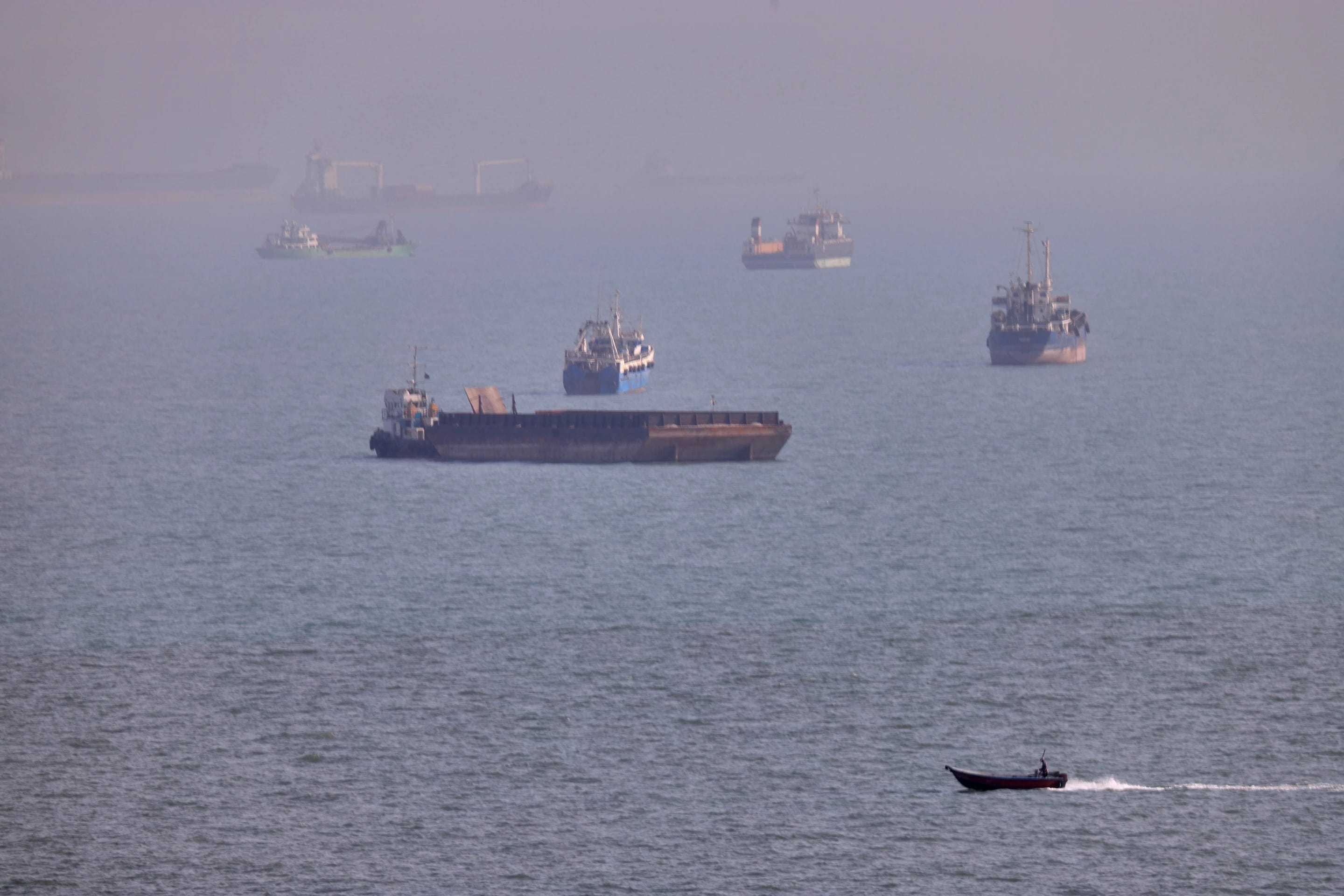
Brent crude surged past $100 a barrel Wednesday for the first time since July after attacks on oil tankers and facilities threatened an already battered Middle East energy supply chain, while U.S. gasoline jumped to an average $4.22 a gallon.
This is no longer just an oil-market story—the damage is showing up at gas stations, in airline fares and throughout the cost of moving practically everything. Brent climbed nearly 3% to $100.72 a barrel, while U.S. benchmark crude rose 2.4% to $95.25. Regular gasoline jumped 7 cents overnight to $4.22 a gallon, more than a dollar higher than a year ago, according to AAA. Diesel reached $5.94 after hitting an all-time high last week, and soaring jet-fuel costs have prompted airlines to cut flights while increasing fares and fees.
The latest surge followed another escalation in the conflict. The U.S. military said it struck five Iranian oil tankers after attempted missile attacks on a Navy warship, while Iranian-backed Houthi attacks ignited fires at Saudi oil facilities. The broader war has already halted most shipping through the Strait of Hormuz, the critical waterway that carried about one-fifth of the world’s oil supply before the fighting began. Recent Houthi attacks also threaten an alternative shipping route Saudi Arabia has relied upon during the conflict.
And $100 oil may not be the ceiling. Bank of America analysts raised their second-half forecast to $83 a barrel (from $76) because of persistent disruptions around Hormuz, while warning that continued restrictions on shipping could push crude into a $95-to-$120 range. Damage to major energy infrastructure could produce temporary spikes as high as $150.
The analysts offered one particularly unwelcome assessment: “In our view, reaching a durable deal before the U.S. midterm elections is increasingly unlikely, and it could remain elusive even beyond that.”
Consumers are already getting the bill. Higher energy prices ripple through trucking, manufacturing, aviation, agriculture, and virtually every supply chain that ultimately ends at somebody’s wallet.
US consumers have already paid an extra $100 Billion in excess fuel costs. Thanks, Trump voters—you did this! Read below for the story.

With negotiations between Washington and Tehran stalled over control of the Strait of Hormuz and attacks now threatening multiple oil routes and facilities, the question isn’t simply whether crude can remain above $100. It’s how much more expensive everyday life gets if the shooting keeps interfering with the world’s fuel supply.
Editor: Oil traders can debate Brent forecasts all day. The rest of us have a much simpler economic indicator—the increasingly obscene number spinning on the gas pump while we’re standing there holding the nozzle. Diesel is near $8 a gallon in the PNW. I’m sure it’s past that in CA.
Source: Associated Press
President Trump gave three White House aides $45,000 apiece and another aide $20,000, according to financial disclosures—and now ethics lawyers are debating whether these were generous holiday gifts or the kind of generosity federal law has opinions about.
Trump Gave White House Aides $45,000 Cash Gifts—Now(!) Ethics Experts Are Raising Questions
President Donald Trump gave $45,000 cash gifts to executive assistant Natalie Harp, communications adviser Margo Martin, and executive assistant Chamberlain Harris, according to financial disclosures, with each payment amounting to nearly one-third of the aides’ $150,000 annual White House salaries. The three women listed the payments as “Cash Gift for Holidays.” Trump also gave $20,000 to Walt Nauta, director of Oval Office operations. He’s the guy who carried around illegally-kept top secret documents at Mar-a-lago.
The amounts are unusual enough that government ethics experts are debating whether the gifts could run afoul of federal restrictions on supplementing government salaries. Richard Painter, who served as chief White House ethics lawyer under President George W. Bush and is a Trump critic, told The Washington Post that the payments appear to violate federal law prohibiting outside supplementation of federal employees’ salaries. His assessment was succinct: “You can’t do that.”
The White House disputes that interpretation. Spokesperson Davis Ingle said Trump has a longstanding practice of giving Christmas gifts to employees and others around him and maintained that these payments were unrelated to the recipients’ government work, making them permissible under applicable legal and ethical rules. Former acting Office of Government Ethics director Don Fox offered a more cautious assessment, saying the available facts don’t clearly establish a violation. He noted that large payments from a superior to a subordinate weren’t something OGE had really contemplated because, as he put it, “This just doesn’t happen.”
The recipients are members of Trump’s longtime inner circle. Harp, sometimes called the “human printer” because she supplies Trump with hard copies of news and social-media posts, has worked for him since 2022. Martin first joined Trump’s White House in 2019 and now documents presidential activities for social media. Harris also worked in Trump’s first administration and was appointed by Trump this year to the U.S. Commission of Fine Arts. Nauta served as Trump’s valet during his first administration and later became a co-defendant in the classified-documents case; those charges were dismissed in 2024.
Whether the payments violate federal law remains disputed rather than established. Fox nevertheless told The Post that such unusually large gifts could raise concerns about employees feeling indebted to the person who gave them the money. The Post reported that ethics experts were unaware of comparable cash payments of this scale from previous presidents to subordinate White House employees. That’s the central issue now: Not whether the disclosed gifts happened, but whether a president personally handing employees tens of thousands of dollars is legally just another holiday present—or something federal ethics rules weren’t designed to see under the Christmas tree.
Editor: The legal question is unresolved, but $45,000 is one heck of a stocking stuffer. At that point, forget the fruitcake—you may need to attach an ethics opinion to the bow. And—was that Trump’s cash or the American taxpayers’?
Source: The Washington Post
Border Patrol is reportedly analyzing Americans’ financial behavior and other data to identify people for traffic stops even when they aren’t suspected of a specific crime—now your bank activity can become a road-trip companion you never invited.
DHS Predictive Policing Teams Are Analyzing Americans’ Financial Activity to Target Traffic Stops

Secretive U.S. Border Patrol units called Predictive Intelligence Targeting Teams, or PITT, are analyzing Americans’ financial activity and other law-enforcement data, then passing potential targets to local police for traffic stops, according to an investigation by 404 Media. The outlet identified PITT operations in Border Patrol’s Spokane Sector in Washington and Laredo Sector in Texas, although Customs and Border Protection declined to say how many such teams exist nationwide.
The people identified by these teams don’t necessarily need to be suspected of a particular crime before the machinery starts turning. In one Montana case, Border Patrol analyst Matthew Phelps reportedly reviewed “law enforcement-sensitive databases” and identified “financial activity patterns commonly associated with illicit narcotics activity” connected to driver Kyle William Olson. Phelps then sent intelligence to Montana Highway Patrol Sergeant James Beck, who stopped Olson because his license plate was partially obstructed. Police ultimately charged Olson with DUI and, later, possession with intent to distribute marijuana.
The troubling question is what happens behind that seemingly ordinary traffic stop. Beck’s report acknowledged that Phelps had identified Olson’s vehicle as having “indicators of possible narcotics trafficking,” while the Border Patrol document said the intelligence wasn’t the “sole basis” for stopping him.
Jake Laperruque of the Center for Democracy & Technology told 404 Media, “The bottom line is genuine probable cause cannot be synthetically generated.” He argued Border Patrol appeared to be using “parallel construction to cloak the reason behind its car stops in secrecy.”
Exactly what financial information Border Patrol accesses—and whether warrants are involved—remains unclear. CBP declined to identify the financial data, analytical methods, or targeting criteria involved, telling 404 Media that Border Patrol uses “intelligence-informed analysis and planning” consistent with applicable laws, privacy protections, and oversight requirements. The investigation follows earlier reporting by the Associated Press that Border Patrol’s broader predictive-policing operation also uses automatic license-plate readers to monitor vehicles. In another cited case, police stopped Alek Schott in Texas, searched his vehicle, and found nothing.
CBP says revealing specific techniques could compromise investigations and agent safety. Civil-liberties advocates argue that secrecy makes meaningful oversight difficult, particularly when financial records, location tracking, and routine traffic violations can intersect to produce police encounters. Therein lies the uncomfortable question: If the government can analyze your movements and financial behavior, privately flag you as interesting, then wait for police to find an ordinary reason to pull you over, how meaningful is the distinction between investigating a suspect and searching for one?
Editor: A busted taillight used to mean you had a busted taillight. When secret federal analysis is sitting invisibly behind the traffic stop, “Do you know why I pulled you over?” becomes a considerably more complicated question.
Source: 404 Media