


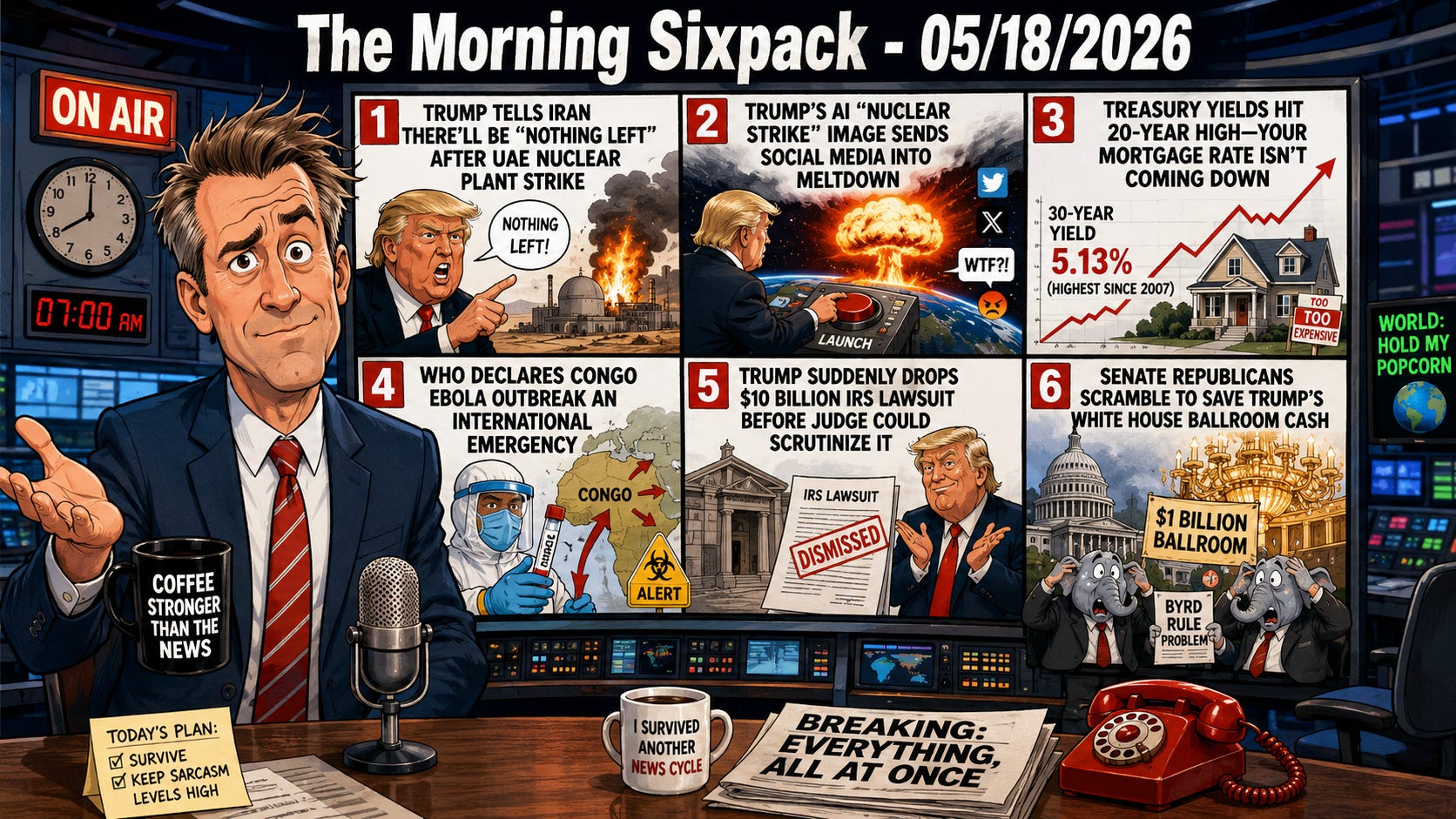
“There would be nothing left” if Iran refuses a deal, Trump warned, as fears of a wider regional conflict spike overnight.
Trump Tells Iran There’ll Be “Nothing Left” After UAE Nuclear Plant Strike
One drone attack on a UAE nuclear facility just poured gasoline on an already collapsing U.S.-Iran peace process-and Trump responded with a threat that sounded a lot more like a countdown clock than diplomacy.
A drone struck an electrical generator at the Barakah Nuclear Power Plant in the United Arab Emirates, igniting a fire and sending geopolitical nerves into overdrive. UAE officials said there were no injuries and no radiological danger, but the symbolism alone was enough to rattle global markets and security analysts.
The strike lands at the worst possible moment. U.S.-Iran peace talks were already hanging by a thread, with both sides dug in over sanctions, security guarantees, and nuclear restrictions. Now the conversation is shifting from diplomacy to retaliation-and fast.
Trump, never exactly known for subtle wording, escalated the rhetoric by warning Iran that failure to reach an agreement could leave the country with “nothing left.” That line is now ricocheting across the Middle East while governments quietly prepare for the possibility that negotiations are dead.
Meanwhile, nobody has officially claimed responsibility for the drone attack. But in a region where every missile launch, cyberattack, and mysterious explosion gets interpreted as a message, this one came through loud and clear.
Editor: Apparently the phrase “fragile ceasefire” now means “one drone strike away from everyone checking oil prices and bunker inventory.”
Source: MSN report
The image showed Trump pressing a giant red button as a mushroom cloud exploded across Earth, triggering backlash, ridicule, and a whole lot of “what timeline is this?” commentary online.
Trump’s AI “Nuclear Strike” Image Sends Social Media Into Meltdown
Trump posted an AI-generated image of himself appearing to launch a nuclear strike-and the internet instantly reacted like someone handed a flamethrower to a guy already yelling in all caps.

The image, shared Sunday night, appears to have been generated using AI tools and follows Trump’s growing habit of posting bizarre fantasy-style graphics online. Previous entries in the collection included a burning Chicago skyline and an image portraying himself as a messiah-like figure. Now we’ve apparently moved on to apocalyptic blockbuster posters.
Critics didn’t exactly hold back. Podcast host Jeff Nadu called Trump a “nutcase” and added, “God help us.” Political commentator Evan Jacobs mocked the idea that someone he accused of having “dementia” could “destroy the earth whenever he feels like it.” Documentary filmmaker Armstrong Clarke summed up the mood online with: “We are so cooked.”
Editor: I wrote this over a month ago… I think when the shit really hits the fan (the midterms), Trump is going to go berserk.
If Trump Orders a Nuclear Strike on Iran, Here’s What Happens Next

A U.S. president can order a nuclear strike on Iran without Congress, without a court, and without anyone else’s approval—and the only thing standing between that order and launch is whether someone in the chain of command decides it’s illegal.
The key quote making the rounds came from Clarke, who wrote: “The most powerful man on earth is making movie posters about himself. This is what happens when a 79 year old discovers Midjourney and has access to actual missiles.” Hard to say if that’s satire anymore when the source material keeps doing the heavy lifting.
The bigger issue isn’t whether the image was a joke. It’s that modern politics has now fused with meme culture, AI image generators, and nuclear imagery so completely that nobody even blinks when the president posts something that looks like a rejected Netflix dystopia thumbnail.
Editor: Somewhere in the Situation Room, there’s probably one exhausted staffer begging for the Wi-Fi password to mysteriously stop working.
Source: Raw Story article
As inflation heats back up and war-driven energy prices surge, investors are dumping bonds and bracing for the Federal Reserve to keep rates higher for longer.
Treasury Yields Hit 20-Year High—and Your Mortgage Rate Isn’t Coming Down Anytime Soon
The 30-year Treasury yield just climbed to levels not seen since 2007, which is Wall Street’s polite way of saying borrowing money is getting painfully expensive again.
The benchmark 30-year Treasury yield surged to 5.13%, while the 10-year hit 4.59%, marking the latest shockwave in a global bond market sell-off. Traders had spent months convincing themselves rate cuts were around the corner. Then inflation reports showed up and ruined everybody’s mood.
Editor: Are we approaching another mortgage meltdown? I think we could be…
MORTGAGE MELTDOWN: What Really Caused the 2008 Financial Crisis

This article is Part 1 of a 3-part series on what really caused the 2008 financial crisis.
April’s CPI and PPI numbers came in hotter than expected, fueled in part by rising oil and energy costs tied to escalating tensions with Iran. That’s reviving fears the Fed may need to tighten policy again—or at minimum keep rates elevated deep into 2026.
For average Americans, this is where economic headlines stop being abstract. Higher Treasury yields directly affect mortgage rates, car loans, credit cards, and business borrowing. So if you’ve been waiting for housing affordability to magically improve, the bond market just laughed in your face.
There is one silver lining: savers are finally getting paid again. Higher yields mean banks and money market accounts can offer better returns, assuming your bank remembers customers exist before handing executives another bonus package.
Editor: The economy has officially reached the stage where getting 5% on savings feels exciting because buying a house now requires the GDP of a small nation.
Source: MSN financial report
Health authorities say the outbreak already shows signs of regional spread, with confirmed cases now appearing in Uganda and Congo’s capital city of Kinshasa.
WHO Declares Congo Ebola Outbreak an International Emergency
The World Health Organization has declared the Ebola outbreak in the Democratic Republic of Congo an international public health emergency as infections spread across borders and officials warn the true scale may be far worse than reported.
The outbreak, centered in eastern Congo’s Ituri province, has seen roughly 246 suspected cases and 80 deaths so far. The WHO stressed this does not yet qualify as a global pandemic emergency, but officials are clearly worried the virus is spreading faster than detection systems can track it.
What makes this outbreak especially dangerous is the strain involved. The virus is linked to the Bundibugyo variant of Ebola, which currently has no approved vaccine or targeted treatment. That leaves health workers relying heavily on isolation, contact tracing, and basic containment measures in regions already struggling with instability and limited medical infrastructure.
The WHO confirmed eight laboratory-verified infections across several health zones, including Bunia and the mining towns of Mongwalu and Rwampara. One infected traveler has already carried the virus to Kinshasa, while neighboring Uganda confirmed two cases, including a 59-year-old man who died after testing positive.
Early Ebola symptoms include fever, fatigue, muscle pain, sore throat, and headaches before progressing into vomiting, diarrhea, rash, and internal bleeding. In other words, exactly the kind of thing global health officials never want to see spreading through crowded cities and border crossings.
Editor: Humanity really looked at the last six years and decided, “You know what this timeline needs? Another outbreak with no vaccine.”
Source: BBC report
The timing is raising eyebrows because the dismissal arrived amid reports the Justice Department may be discussing a massive settlement tied to Trump allies claiming mistreatment under Biden.
Trump Suddenly Drops $10 Billion IRS Lawsuit Before Judge Could Scrutinize It
Trump, his sons, and the Trump Organization abruptly dropped their $10 billion lawsuit against the IRS just days before a federal judge was set to examine whether the case even legally belonged in court.
The lawsuit centered on the leak of Trump’s tax information by former IRS contractor Charles “Chaz” Littlejohn, who disclosed years of tax records involving wealthy Americans, including Trump. But Monday’s filing gave no explanation for why the president and his legal team suddenly walked away from such a massive case.
What makes this especially awkward is that U.S. District Judge Kathleen Williams had already started questioning whether the lawsuit made constitutional sense in the first place. Trump was effectively suing agencies under his own executive authority, which raised the uncomfortable issue of whether there was even a legitimate legal conflict for the courts to resolve.
The filing dismissed the case “with prejudice,” meaning Trump cannot simply refile the same claims later. It also included unusually pointed language arguing that the dismissal should prevent the judge from issuing any ruling analyzing the merits of the lawsuit. Translation: Everybody exits the courtroom before the referee starts asking hard questions.
Meanwhile, controversy is building around reports that the DOJ has discussed a possible $1.7 billion compensation fund for Trump allies who claim they were unfairly targeted during the Biden administration. Democrats are already calling the idea a political “slush fund,” while the DOJ has not confirmed whether the lawsuit dismissal is tied to any behind-the-scenes settlement talks.
Editor: Funny how a $10 billion lawsuit disappears right when a judge starts asking whether it was legally real in the first place. Pure coincidence, obviously.
Source: CNBC report
What was pitched as a prestige project is rapidly turning into a political liability, with Democrats branding it “Trump’s palace” and Republicans privately worried about defending up to $1 billion in taxpayer spending on chandeliers and security upgrades.
Senate Republicans Scramble to Save Trump’s White House Ballroom Cash
Senate Republicans are heading toward a messy public fight over funding Trump’s proposed White House ballroom after the Senate parliamentarian threw a wrench into the plan-and some GOP senators are quietly begging for an escape hatch.
The Senate parliamentarian ruled that the ballroom funding violated the Byrd Rule, meaning it can’t automatically pass through budget reconciliation with a simple majority. That’s a major problem for GOP leaders trying to jam through Trump’s immigration and spending package this week. Republicans now plan to rewrite the language and try again.
Behind closed doors, though, nerves are showing. Multiple Republican senators reportedly complained during a private lunch meeting about having to defend spending hundreds of millions in taxpayer dollars on a 90,000-square-foot ballroom while voters are getting hammered by healthcare and grocery costs. One GOP senator reportedly admitted: “I don’t think they have the votes for it.”
Democrats smell blood in the water. Chuck Schumer has already started hammering vulnerable Republicans as “the ballroom Republicans,” accusing them of prioritizing “Trump’s chandelier over your child’s care.” Democrats are preparing multiple amendments forcing Republicans to vote on redirecting ballroom money toward healthcare and affordability measures instead. In other words, this is about to become campaign-ad material at industrial scale.
The funniest part may be the legal gymnastics now unfolding behind the scenes. Republicans reportedly want to strip direct references to the ballroom from the bill to survive Senate rules scrutiny. But doing that could weaken future arguments that Congress officially authorized the project in the first place. So now they’re trying to simultaneously hide the ballroom funding and legally validate it at the same time. Washington efficiency at its finest.
Editor: Nothing says “we understand struggling Americans” quite like a billion-dollar debate over ballroom upgrades while people finance gas, milk, and eggs on credit cards.
Source: The Hill report