



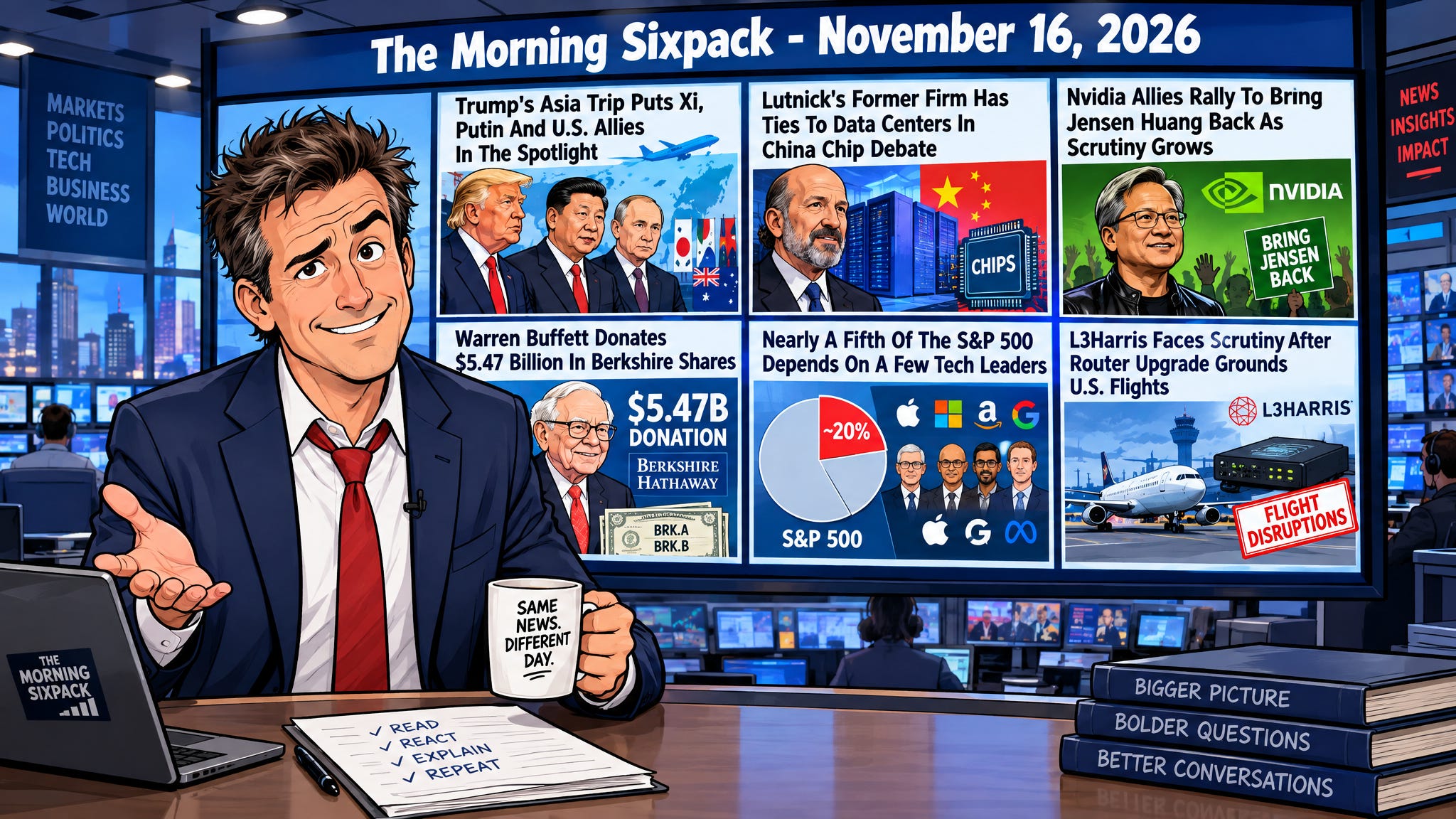
The Morning Sixpack stays free because the news that shapes your life should not be hidden behind a paywall. Paid subscribers are not paying for access. They are helping fund the research, writing, and independent voice that goes into every issue. Become a paid subscriber and help keep smart, honest news analysis free for everyone.
Trump is heading to Asia for a three-way summit with Xi and Putin, where even a photo op may count as a major deliverable.
Trump’s Asia Trip Puts Xi, Putin And U.S. Allies In The Spotlight
President Trump is traveling to the Philippines and China this week for meetings with U.S. allies, Chinese President Xi Jinping and Russian President Vladimir Putin. The trip includes a trilateral summit with Xi and Putin, a gathering that the White House says is intended to open talks about reducing nuclear stockpiles. Officials do not expect an agreement on denuclearization. Trump is expected to spend about three days in the region.
The summit’s political image may matter more than any deal it produces. Trump has said he wants to discuss the Iran war and denuclearization, but former U.S. Ambassador Edgard Kagan said China resists trilateral nuclear talks because it does not want to be boxed into a subordinate position or set a precedent for future negotiations. Russia, meanwhile, could benefit from Putin appearing alongside Trump and Xi as its war with Ukraine approaches its fifth year. The White House says Ukraine is not expected to come up, and there are no plans for a separate Trump-Putin meeting.
Trump and Xi will also revisit the trade truce reached at last year’s APEC summit in Busan. The United States lowered some tariffs, while China agreed to loosen restrictions on rare-earth exports, but U.S. officials say deliveries have not met their expectations. Kurt Tong of The Asia Group described the arrangement as functional despite ongoing friction and expects it to be renewed, either during the China visit or at the G20 summit in Miami.
Before traveling to China, Trump will meet allies in Manila, including leaders from India, Japan, and Australia. The White House also says he plans to sign a trade deal with Thailand. The meetings give regional leaders a chance to assess how Trump approaches allies after his party’s midterm losses, including whether his conduct toward Indian Prime Minister Narendra Modi changes.
The trip also follows the resignation of Nvidia CEO Jensen Huang, who admitted to an extramarital affair with Alice Huang, whom U.S. intelligence officials reportedly believe was recruited by China’s top spy agency; NPR said it has not independently confirmed those reports. Trump administration officials face questions about what they knew and how much access Huang had to the president and his circle. Commerce Secretary Howard Lutnick has agreed to testify before the Senate Banking Committee, while the White House says Trump is not expected to raise Huang’s case with Xi and will focus on trade.
Editor: When a summit’s clearest deliverable may be the group photo, the cameras are already doing a lot of the negotiating.
Source: NPR
A Malaysian data center could give a Chinese tech giant access to Nvidia’s top AI chips—and Howard Lutnick is helping write the rules for that business.
Lutnick’s Former Firm Has Ties To Data Centers In China Chip Debate
A data center under construction in Malaysia is expected to provide Nvidia’s advanced AI servers to Chinese tech giant Tencent. The arrangement would be legal: U.S. rules bar direct sales of the most advanced chips to Chinese companies, but firms can rent computing power from data centers outside China. The facility, known as A201, is being built by Singapore-based Bitdeer and is expected to open next year. The company says the project could generate $1.7 billion in revenue over five years.
Bitdeer has financial ties to Cantor Fitzgerald, the firm Howard Lutnick led for decades before becoming commerce secretary. Cantor helped arrange Bitdeer stock offerings, including one this year for up to $1 billion, and holds a stake through its investment in Tether. Lutnick has recused himself from Cantor matters and transferred his remaining ownership to his family. The Commerce Department says he follows his ethics agreements, and there is no evidence Cantor’s investments influenced his policy deliberations.
The overlap has drawn scrutiny because Lutnick is shaping rules that could restrict data centers serving Chinese customers. The Commerce Department has reportedly favored a narrower proposal covering seven countries, including Malaysia and Singapore, and applying only to future chip shipments. Under that approach, companies would notify the government when Chinese customers use their facilities to train AI models, but would not automatically need a license. Other administration officials have pushed for broader restrictions.
The dispute is over whether overseas data centers are a loophole in U.S. chip controls or a valuable market for American companies. China has been barred from directly buying Nvidia’s most advanced chips since 2022, but Chinese firms can rent access from facilities in Southeast Asia. Chris McGuire, a former Biden administration official, warned that restricting only selected countries could push Chinese customers to data centers elsewhere. President Trump revoked Biden-era rules on remote access to U.S. chips, and his administration has yet to settle on replacement rules.
Cantor has worked with other data center businesses as well, while major investors including Bain Capital, Citadel, and Blackstone have backed AI computing projects across the region. Lutnick’s Commerce Department has also faced criticism over Nvidia’s access to rule-making and investigations, amid a separate controversy involving former Nvidia chief Jensen Huang and a company linked to alleged chip smuggling. The department says Lutnick makes decisions in the best interests of the United States and does not discuss its business with his sons. The broader question now falls to him: how tightly to regulate a business that could benefit both U.S. chipmakers and Chinese AI firms.
Editor: The ethics paperwork may be in order, but the policy stakes are sitting right there in the family business section.
Source: The New York Times
Jensen Huang’s Silicon Valley allies want him back at Nvidia, while Washington is asking whether the company’s leadership let chip controls slide.
Nvidia Allies Rally To Bring Jensen Huang Back As Scrutiny Grows
Jensen Huang’s supporters are campaigning for Nvidia’s board to reinstate him as CEO after his resignation last week. A petition called “Stand With Jensen” had gathered 175,000 names by Monday morning, including confirmed signatures from several tech executives and investors. Some people whose names appeared on it said they had not signed. President Trump said he would support Huang’s return, saying he believed Huang had “learned a big lesson.”
The push to bring Huang back is colliding with growing scrutiny of Nvidia’s conduct and leadership. Treasury Secretary Scott Bessent urged the board to hire an outside CEO, citing questions about the company’s sales to Southeast Asian data centers that serve Chinese AI firms. He said the board and outside counsel should provide answers within 10 days. Nvidia’s board says it has hired an executive search firm but has not approached candidates.
Huang resigned after reports of affairs with two women, including Alice Huang, a Singapore data center executive whom U.S. officials suspect of passing information to Chinese intelligence. Her company, Megaspeed, became a cloud partner of Nvidia and could buy large numbers of its chips; it is also under investigation over alleged chip smuggling into China. Megaspeed has said Alice Huang left the company in August 2025. Nvidia has named longtime finance chief Colette Kress interim CEO.
Supporters say Huang was a champion of open-source AI and argue that restricting Nvidia’s business could give Chinese chipmaker Huawei room to catch up. Replit CEO Amjad Masad said industry peers fear that “a champion of open source was being taken down.” Some Nvidia employees have signed the petition, and employees have discussed holding a demonstration at the company’s California headquarters.
Critics say the issue extends beyond Huang’s personal conduct to the company’s compliance culture and sales practices. Yale governance expert Jeffrey Sonnenfeld said Nvidia’s own code of conduct provided solid grounds for the board’s action, and warned that Huang’s involvement in deals with companies accused of helping China evade export controls would face continued scrutiny. Bessent questioned whether Nvidia had pressed “seemingly illicit sales” to boost revenue. The board now has to weigh a leader’s strong support among allies against questions that could reach well beyond one executive’s job.
Editor: Silicon Valley’s petition machine is humming, but Nvidia’s board has a bigger problem than counting signatures.
Source: The Wall Street Journal
Warren Buffett is giving away another $5.47 billion in Berkshire shares—and says kindness still beats the market.
Warren Buffett Donates $5.47 Billion In Berkshire Shares
Warren Buffett said Monday he will donate 9.225 million Berkshire Hathaway Class B shares, worth about $5.47 billion, to four charities led by his children. The gifts will go to the Susan Thompson Buffett Foundation, the Sherwood Foundation, the Howard G. Buffett Foundation, and the NoVo Foundation. Buffett said his confidence in Berkshire remains “as strong as ever.” He still owns about 13% of the company.
The donations reflect Buffett’s growing focus on passing wealth to his children’s foundations. He has now given those charities more than $29 billion in Berkshire stock, and says he trusts his children completely to distribute it. Buffett has said he wants his shares distributed by the end of 2034. He has also donated more than $47 billion in Berkshire shares to the Gates Foundation since 2006, but stopped after last year.
Buffett stepped down as Berkshire’s CEO at the end of 2025 and as chairman in September. Greg Abel succeeded him as CEO, while Buffett’s son Howard became non-executive chairman. Buffett said Abel has exceeded his expectations and that he is more confident than ever about Berkshire’s future.
Berkshire owns businesses including Geico, BNSF Railway, and a range of energy, industrial, and retail companies. It ended September with more than $335 billion in stocks, including Alphabet, American Express, Apple, and Coca-Cola. Its share price hit a record this month, and was up 18% through Friday since Abel took over, giving Berkshire a market value of about $1.26 trillion.
Buffett’s Thanksgiving message also returned to the value of kindness, echoing a point made last year by his longtime partner, Charlie Munger, who died in 2023. “A year later, I would only add that it compounds, and at a better rate than anything Charlie and I ever bought,” Buffett wrote. He urged readers to thank someone who had helped them—and to become a benefactor to someone else.
Editor: Buffett has spent a lifetime compounding wealth. He’s still making the case that kindness compounds better.
Source: Reuters
Musk says a founder may be impossible to replace. His investors would probably like to see somebody try.
Nearly A Fifth Of The S&P 500 Depends On A Few Tech Leaders
Tesla, SpaceX, Meta, and Nvidia together account for almost 20% of the S&P 500’s market value, and each has a founder or executive whose departure could shake the company. Their filings warn that losing a key leader could seriously harm the business. Yet the companies offer little public detail about who would take over. That leaves investors weighing enormous market influence against a basic question: what happens if the person at the top suddenly can’t lead?
Jensen Huang’s exit from Nvidia has put succession planning back in the spotlight. Elon Musk replied “True words” to an X post saying founders cannot simply be replaced, even as Tesla and SpaceX investors have raised concerns about his own succession for years. SpaceX has warned that finding a replacement with Musk’s skills and market credibility could be difficult and uncertain. Tesla’s filings mention a succession framework, but tie it to Musk’s eligibility for the final two tranches of his $1 trillion pay package.
Meta’s filings warn that Mark Zuckerberg’s participation in high-risk activities—including combat sports and recreational aviation—could leave the company exposed if he became unavailable. Zuckerberg also holds majority voting control, giving him power over shareholder votes and board membership. The filings disclose no succession plan for the CEO role. Nvidia has named CFO Colette Kress interim CEO, but it has not said whether she will stay in the position.
There are examples of major companies moving beyond founders once thought indispensable. Apple’s valuation grew substantially in the years after Steve Jobs died, while Alphabet, Microsoft, and Amazon have all changed CEOs. Anthropic has built part of its succession process into its structure: a trust elects most of its board, and a company owned by its co-founders can appoint a successor if one dies or is incapacitated.
Investors say Musk’s influence makes the question especially urgent, with one Tesla investor citing Musk’s public profile and involvement in geopolitical conflicts as added concerns. The article notes that Tesla, SpaceX, Meta, and Nvidia employ at least 280,000 people, putting a lot of workers and investors in the path of any leadership shock. Governance expert Nell Minow calls succession planning a board’s most important job—and one founder-led companies often neglect. As Huang’s departure shows, a leader may be hard to replace; that does not make the company’s exposure disappear.
Editor: “Indispensable” is a flattering word right up until the board needs a replacement.
Source: The Washington Post
L3Harris calls itself a “trusted disruptor.” Its router upgrade recently disrupted air travel across the country.
L3Harris Faces Scrutiny After Router Upgrade Grounds U.S. Flights
A router installation by defense contractor L3Harris triggered a cascade of network failures that led the FAA to ground domestic flights for hours on Friday. The disruption upended thousands of flights and travelers’ plans. Transportation Secretary Sean Duffy said the department is investigating whether “incompetence” or faulty equipment was to blame. L3Harris says it is cooperating and taking the incident seriously.
The installation had FAA approval, and an agency representative was present. The FAA said its representative helped an L3Harris employee enter a facility to install the equipment. Investigators are examining how a misconfigured data-broadcast feature on a network device spread unnecessary information to other equipment and disrupted flight-routing centers. They have not yet determined exactly how the failure propagated.
L3Harris has maintained the FAA’s telecommunications infrastructure since 2002. The system carries communications air-traffic controllers rely on to guide aircraft, and it is now undergoing a multibillion-dollar upgrade that includes replacing copper lines with fiber. The FAA has pushed the contractor to move quickly, with thousands of upgrades planned around the country. L3Harris said the work was about 70% complete, and Duffy has warned that disruptions could continue until the project is finished, currently expected by the end of 2028.
The ground stop puts an unusual spotlight on a company often brought in to take over complex projects other contractors struggled with or avoided. L3Harris has worked on retrofitting a donated 747 for presidential use after delays in Boeing’s replacement-aircraft program. In January, the Pentagon made an unusual $1 billion investment in its missile-parts business to help fund new factories.
The incident also lands during a leadership transition: Sam Mehta took over as CEO in August after the board ousted longtime chief Chris Kubasik over a conduct breach. L3Harris reported $21.9 billion in revenue last year, but its shares have fallen more than 11% so far this year as Congress moderates defense spending. The company’s government work spans decades and brings steady revenue, but the FAA upgrade shows how quickly a routine change to aging, always-on infrastructure can become a national problem.
Editor: When the network is carrying the nation’s air traffic, “move quickly” and “don’t break anything” make for a tricky project plan.
Source: The Wall Street Journal
Read The Morning Sixpack Archives here:


