



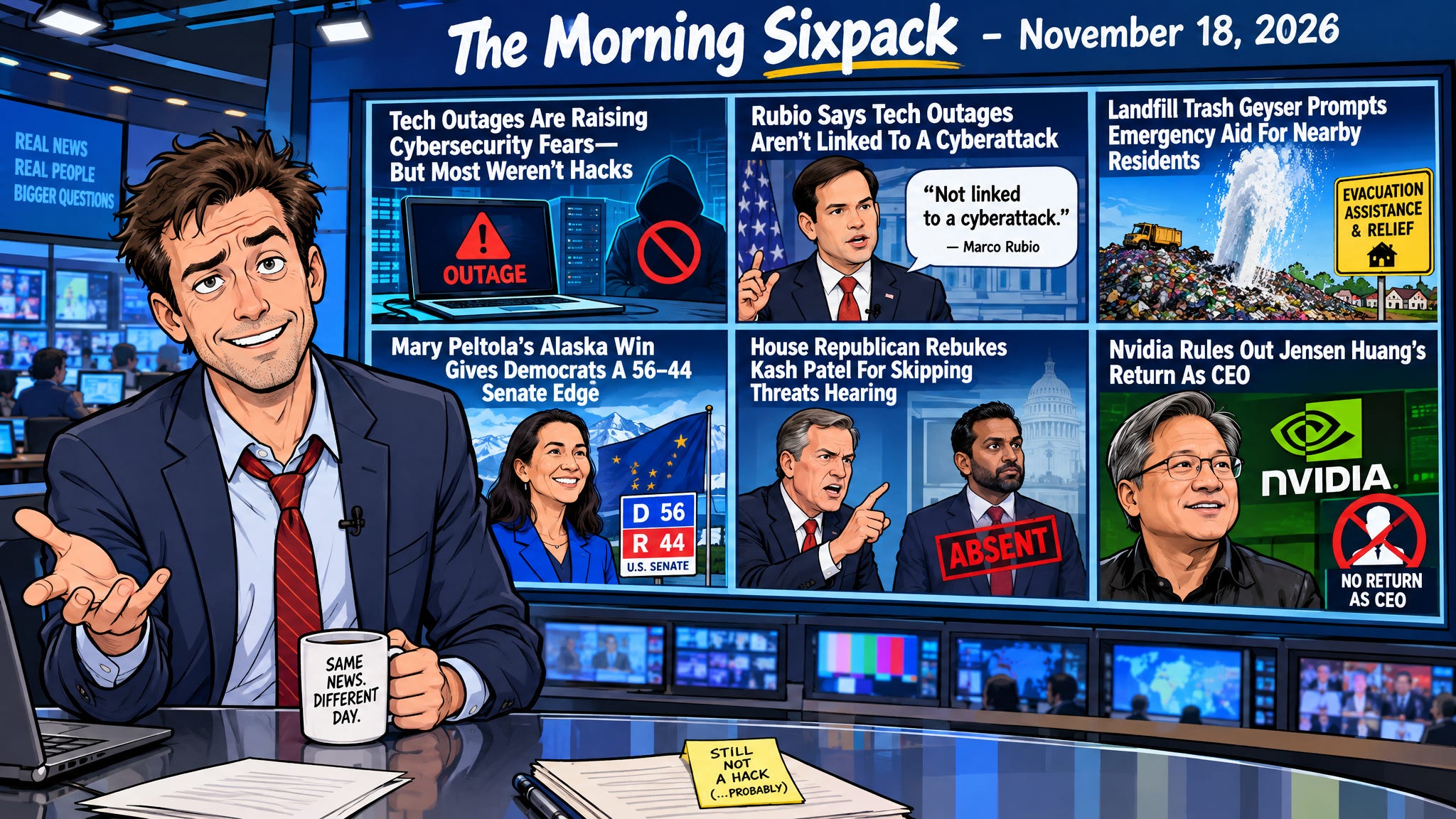
The Morning Sixpack stays free because the news that shapes your life should not be hidden behind a paywall. Paid subscribers are not paying for access. They are helping fund the research, writing, and independent voice that goes into every issue. Become a paid subscriber and help keep smart, honest news analysis free for everyone.
The outages weren’t a cyberattack, but a year of AI-assisted bug hunting has made software patches feel like playing Jenga with the internet.
Why This Week’s Big Tech Outages Weren’t Cyberattacks After All
A string of outages at Microsoft, the FAA, Workday, Chase, United Airlines, the NSA and Apple disrupted email, air travel, banking and internal systems over several days. The incidents prompted fears of cyberattacks, especially after the FBI warned that hackers were using a new AI tool called Artex. But the organizations involved said the outages were caused by technical problems, often tied to system upgrades—not hacks.
The timing of the FBI’s warning made the outages look connected, but the bureau said it wasn’t. “There’s been so much reporting of the impending AI apocalypse, and then when ordinary people see systems going offline, they immediately jump to the conclusion that it’s cyber, even if it’s not,” said Iain Mulholland, Salesforce’s chief information security officer. An Infoblox analyst said people should generally assume an outage is an outage unless evidence points to an attack.
The anxiety has a real backdrop: security teams are facing relentless attacks and a surge in software vulnerabilities and fixes. Anthropic’s Mythos, released in April and designed for cybersecurity work, proved unusually effective at finding bugs; OpenAI followed with models of its own. Microsoft issued patches for about 1,400 security flaws in a single monthly update last month, compared with roughly 170 a year earlier.
Newly uncovered flaws in PHP, Linux and Java have also pushed organizations to move quickly. Some companies shut down websites rather than risk being hacked through PHP vulnerabilities. Each patch changes code, however, and those changes can produce unexpected problems—raising the odds that a rushed fix disrupts a system.
The internet is far more woven into daily life than it was during the Y2K preparations, making outages more consequential. Cyberattacks have caused major shutdowns before, including the 2023 MGM incident, the 2021 Colonial Pipeline ransomware attack and the 2017 NotPetya virus. But experts say attack-driven outages remain rare, even as AI helps uncover flaws and adds pressure to patch them.
Editor: It’s a bad week for software when the fixes start making headlines alongside the bugs.
Source: The Wall Street Journal
Rubio says there’s no evidence the outages are linked or malicious. Maybe he should send that memo to the conspiracy corner of his own party.
Rubio Says “Zero” Evidence Links This Week’s Tech Outages to Malicious Actor
Secretary of State Marco Rubio said the administration has “zero” evidence that a string of technology outages was connected or caused by a malicious actor. Speaking in Manila as he traveled with President Trump, Rubio said there was no reason to believe the incidents involved hackers, criminals or a foreign government. The disruptions affected Microsoft services, air traffic control, banks, United Airlines and an internal National Security Agency network.
The outages unfolded across several days, and officials have attributed them to separate technical problems. Microsoft cited a network capacity upgrade, the FAA blamed a router upgrade, and JPMorgan Chase said a software bug disrupted some services. United reported an internal system outage, while the NSA said its classified communications network went down after routine maintenance. U.S. intelligence officials said they were not seeing evidence of a cyberattack.
Trump brushed off concerns about Chase’s outage, saying, “It’s life. When you’re big and powerful and you have all the money, things like that happen.” His response came as criticism grew over the administration’s handling of the disruptions. Some Trump allies and political critics called for clearer explanations, while others claimed the outages were coordinated without offering evidence.
Former Trump press secretary Karoline Leavitt urged the White House to be more transparent. Director of National Intelligence Jay Clayton said the government believed the incidents stemmed from security upgrades that took longer than expected or ran into unexpected problems. Former Homeland Security spokesperson Tricia McLaughlin and conservative commentator Meghan McCain also pressed the administration to explain what was happening.
Rubio stepped in to reassure the public as the outages fueled suspicion across the political spectrum. Right-wing personality Laura Loomer called the events a coordinated cyberattack and urged Trump to return to the United States, but provided no evidence. Rubio’s message was clear; whether it quiets the speculation is another matter—perhaps he and Patel should compare notes.
Editor: Maybe the White House could save everyone some time and put Rubio’s “zero evidence” statement on repeat. Or at least gift him a WSJ subscription!
Source: NPR
Today’s vocabulary lesson is “trash geyser”—a phrase best learned from a distance, preferably with a hotel room and an air purifier.
Methane Eruption at Chiquita Canyon Landfill Sends Trash Skyward Near Los Angeles
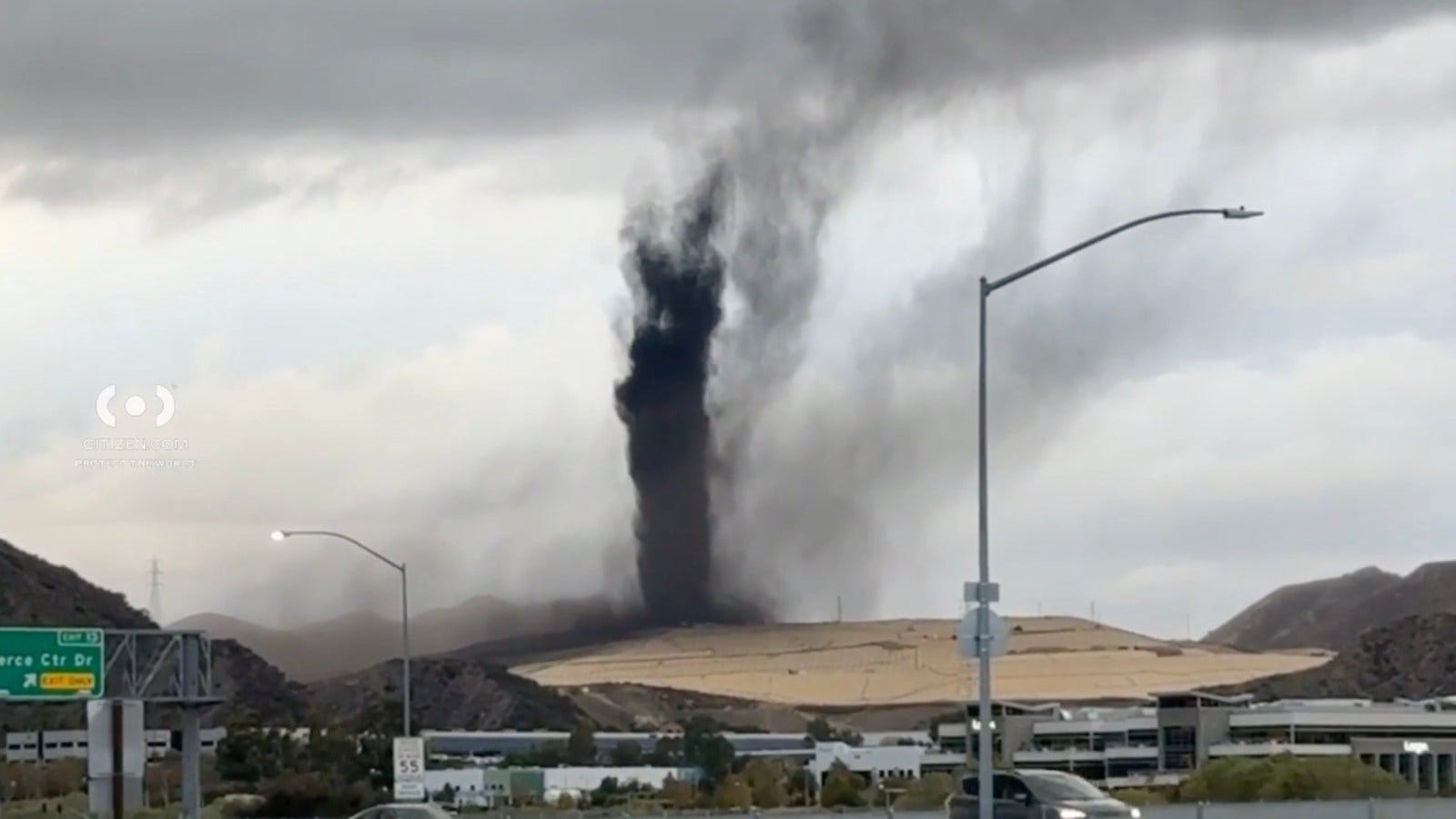
Los Angeles County health officials have ordered the operators of Chiquita Canyon Landfill to provide hotel stays and other emergency assistance after a violent eruption sent decomposing garbage and methane into the air. The release Monday afternoon caused strong odors in nearby communities, including Val Verde, Hasley Hills, Industry, Cambridge and Hillcrest. The county directive calls for temporary lodging, filtered-air refuge centers, transportation help and air purifiers or other materials to improve conditions inside affected homes.
The eruption happened as workers drilled a new well at the Castaic landfill. Fire officials said crews encountered a pressurized pocket of methane about 150 feet below the surface, sending debris and gas upward in a towering plume. There was no fire, officials said. Six workers were decontaminated by hazardous-materials crews, and four were taken to hospitals as a precaution.
Evacuation warnings were issued for nearby communities, with residents told to stay indoors, shut windows and doors, and prepare to leave if instructed. County fire officials lifted the advisories Monday night. Fire Capt. Aaron Katon said air-quality monitoring found no danger to surrounding neighborhoods, though the public health department ordered the operators to address residents’ exposure to the odors.
The landfill operators said the incident occurred during work on a well intended to address an ongoing underground heat-producing chemical reaction. They said gases and particulate matter escaped, no liquids were released, and drilling stopped immediately. The cause of the eruption remains under investigation.
Chiquita Canyon has faced years of complaints involving foul odors, contaminated liquid and the underground reaction. It stopped accepting waste in January 2025. Last month, California Attorney General Rob Bonta sued the operators over alleged hazardous-waste violations; the company has disputed many of the allegations.
Editor: “Trash geyser” is a vivid reminder that some problems do not stay buried.
Source: KTLA
Alaska just gave Democrats a Senate majority large enough to make procedural filibusters a lot less useful. That’s one way to end a long election night.
Mary Peltola Beats Dan Sullivan, Handing Democrats 56–44 Senate Majority
Democrat Mary Peltola defeated Republican Sen. Dan Sullivan in Alaska, giving Democrats a 56–44 majority in the Senate next year. The Associated Press called the race Tuesday, making it the last Senate contest decided. Peltola, a former congresswoman, will be Alaska’s first Democratic senator since Mark Begich left office in 2015.
Peltola’s victory caps a historic Democratic sweep of nine new Senate seats. She is the first Alaska Native woman elected to the Senate and one of two Indigenous women to win Senate races this year, alongside Minnesota’s Peggy Flanagan. Alaska backed President Trump by 13 points in 2024, but this year’s contest became one of the country’s most competitive.
Cost of living was central to the campaign in a state where fuel and groceries are already expensive and many communities lack road connections to the national network. Peltola tied Sullivan to Trump’s tariffs and the war in Iran, which pushed prices higher, while emphasizing support for gun rights and fossil-fuel development. Sullivan highlighted his work for Alaska Native communities and military interests, and criticized Peltola’s attendance and legislative record.
Alaska’s ranked-choice system and two similarly named candidates made the count especially contentious. Republicans argued that Gerald Heikes and independent Dan J. Sullivan could siphon votes from the incumbent; Democrats denied orchestrating their candidacies. President Trump publicly insisted the race was over before the count was complete, while the Justice Department sued to block certification under certain vote margins. A federal judge dismissed the suit, ruling that the department offered no workable way to determine voter intent without compromising ballot secrecy.
Peltola previously represented Alaska in the House from 2022 to 2025, winning a special election after Rep. Don Young’s death and then a full term. She built relationships with rural lawmakers and Alaska Republicans, and was among the least partisan Democrats in the House. Republicans also struggled to make Sullivan’s record resonate as voters reacted to national policies and wanted change, according to a veteran state GOP consultant.
Editor: When groceries and gas cost a fortune, telling voters how well your national talking points are working is a tough campaign strategy.
Source: The Washington Post
The FBI director skipped Congress’ annual threats hearing for the second year running. Apparently the threats can wait; the calendar couldn’t. I bet he had to bang his country singer girlfriend.
Kash Patel Skips Annual Worldwide Threats Hearing for Second Year in a Row
Rep. Andrew Garbarino, the Republican chair of the House Homeland Security Committee, criticized FBI Director Kash Patel for not appearing at Wednesday’s annual hearing on worldwide threats. Garbarino said the date was first offered in August and that repeated efforts to find another date went nowhere. Patel “made clear that he had no intention of appearing,” Garbarino said.
Garbarino called Patel’s absence a break from committee precedent. The hearing is held regularly to let the public hear from the leaders of Homeland Security, the FBI, and the intelligence community about threats facing the country. Patel’s predecessor, Christopher Wray, testified before the panel six times. FBI Deputy Director Christopher Raia attended in Patel’s place.
Homeland Security Secretary Markwayne Mullin and Director of National Intelligence Jay Clayton also testified. Garbarino thanked Raia for answering questions but said the FBI director was expected to represent the bureau. The committee’s focus on worldwide threats, he said, should transcend politics.
Rep. Bennie Thompson of Mississippi, the committee’s top Democrat and its incoming chair, also criticized Patel’s absence. Thompson said it was the second consecutive year Patel had missed the hearing, limiting Congress’s ability to conduct oversight. He accused Patel of shirking his responsibilities as both FBI director and a witness before the committee.
Thompson also listed Patel’s reported trips and public activities, including flying to his girlfriend’s concert, VIP snorkeling at a Pearl Harbor memorial site, and getting stone-cold drunk with hockey teams. He questioned why Patel had time for those activities but not to testify. The FBI had not responded to The Hill’s request for comment.
Editor: Congress scheduled this in August. “Couldn’t make it” is doing some heavy lifting.
Source: The Hill
Jensen Huang says he’d return to Nvidia if the board wanted him. The board says it doesn’t. His Trump ties are a character assessment; the company’s stated reason is his conduct.
Nvidia Board Rejects Jensen Huang’s Offer to Return as CEO
Nvidia’s board does not plan to reinstate Jensen Huang as CEO, despite his public offer to return. Chairman Harvey C. Jones said during Tuesday’s earnings call that the board unanimously accepted Huang’s resignation as president, CEO, and director after disclosure of personal behavior the company said violated its code of conduct and cultural standards. “The Nvidia board unanimously accepted his resignation and does not intend to reinstate Jensen as CEO,” Jones said.
Huang had said he would return if the board decided it was in the company’s best interests. In a post on X, he cited calls from Nvidia employees, investors, business partners and customers asking him to come back. The board has now answered that question: it is moving on.
Huang resigned last week after revelations of multiple extramarital affairs, including one with Alice Huang, a former Megaspeed executive accused by U.S. intelligence officials of having ties to China’s Ministry of State Security. She has maintained a close relationship with the former Nvidia chief for years. Critics have questioned whether the relationship affected Nvidia’s business with China.
The controversy has triggered an independent board investigation into Huang’s activities and an SEC probe into Nvidia. Chief Financial Officer Colette Kress is serving as interim CEO while the board searches for a permanent replacement. Jones said the company is considering both internal and external candidates.
Nvidia is at the center of the AI industry, making the leadership crisis consequential well beyond the company. Huang’s association with Trump may be its own measure of his judgment, but Nvidia’s decision rests on the conduct it says violated company standards. The board has made clear that his offer to return won’t change its course.
Editor: “I’d be honored to return” is a gracious offer. “We’re good” is a pretty definitive answer. But I’m sure Trump will have his say in this as well. “Welcome back, Jenson!”
Source: TechCrunch
Read The Morning Sixpack Archives here:


