




The Morning Sixpack stays free because the news that shapes your life should not be hidden behind a paywall. Paid subscribers are not paying for access. They are helping fund the research, writing, and independent voice that goes into every issue. Become a paid subscriber and help keep smart, honest news analysis free for everyone.
Anthropic’s record IPO raised $81.3 billion, then investors promptly reminded everyone that “record-breaking” and “risk-free” are not synonyms.
Anthropic Shares Slide After Record-Breaking IPO
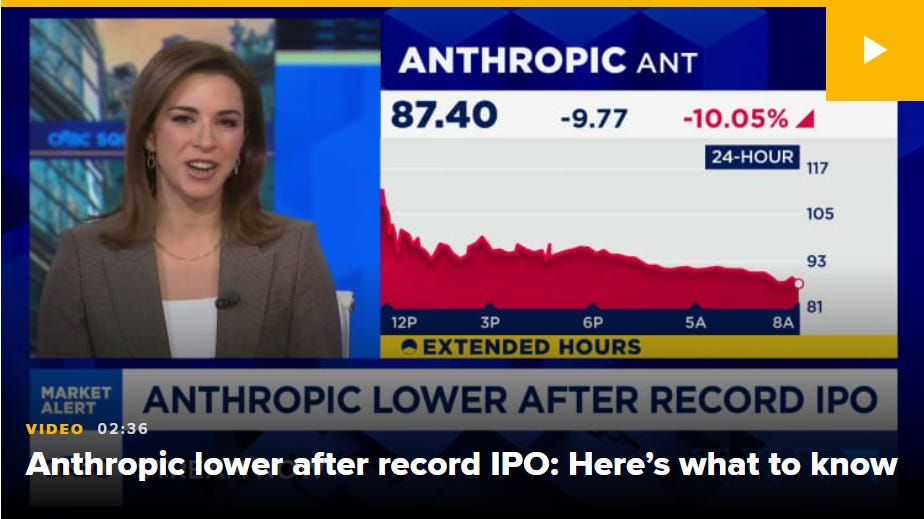
Anthropic shares fell 10% Friday, a day after the AI company made its Nasdaq debut in the largest IPO ever. The stock opened Thursday at $111.50 and closed at $97.17 after losing ground through the day. Investors had hoped the offering might revive enthusiasm for AI stocks, but worries about the sector continued to weigh on markets.
The broader AI trade remained under pressure, pulling chipmakers and cloud giants lower with it. Nvidia and AMD shares fell Friday, as did Amazon and Microsoft. The downturn comes amid concerns about AI infrastructure spending, rising interest rates, and public unease about data centers. The article also points to Jensen Huang’s departure as Nvidia CEO as a factor that has soured sentiment.
Treasury Secretary Scott Bessent praised Anthropic in a Friday CNBC interview, calling it an “only in America story.” He said the company had been “very cooperative” in pre-testing models with the Trump administration. Bessent recalled that Anthropic began in 2021 with seven people in a San Francisco park, “with laptops and a dream,” before reaching what he described as the most valuable IPO in history.
Anthropic’s relationship with the government has been tense this year, following two public disputes, though the strains began to ease in September. That month, CEO Dario Amodei attended a private White House dinner with President Donald Trump. Bessent also said one of Anthropic’s seven co-founders plans to make a large donation to Trump Accounts, investment accounts established by the administration for U.S. children.
Analysts offered mixed views on the newly public AI model company. Seaport Research rated the stock neutral, calling Anthropic an “incredible company” while warning that its valuation requires much faster revenue growth over the next two years. William Blair rated it outperform, citing the company’s efficiency and potential to become significantly profitable over time, despite substantial infrastructure costs. Both firms acknowledged the uncertainty around an industry still in its early stages.
Editor: Even a record IPO can’t make investors forget that the AI buildout comes with a very large bill.
Source: CNBC
The FAA is trying to replace an outdated air traffic network while keeping planes moving—and last week showed how expensive the timing can get.
FAA Modernization Push Raises Questions After Network Failure
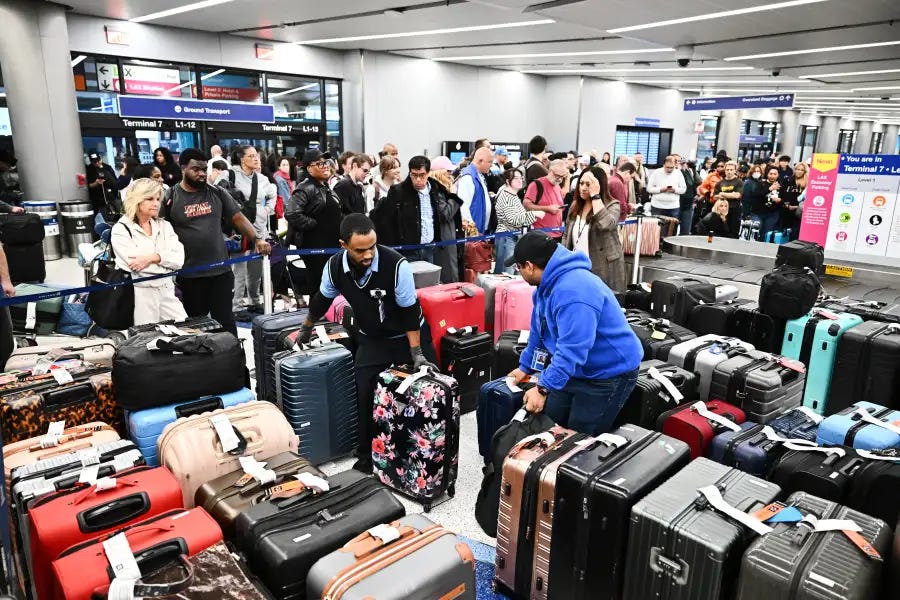
A telecommunications failure triggered a nationwide FAA ground stop last Friday, canceling thousands of flights and exposing the risks of an air traffic system still reliant on decades-old technology. The agency says the disruption began during work to install a router at a remote Arkansas facility, part of an effort to replace copper wiring with fiber-optic cable. The FAA has not determined the precise cause of the failure.
The modernization effort now faces a difficult balancing act: replace fragile equipment without disrupting a system that must operate around the clock. FAA Administrator Bryan Bedford called the agency’s federal telephone network “patchwork” and “archaic,” and said it needs to be replaced quickly while maintaining safety. Former officials say outdated systems are costly to maintain and difficult to connect with modern equipment. Congress allocated $12.5 billion for upgrades last year, but former FAA executive William Voss cautioned that replacing the network is a complicated undertaking.
The Friday timing of the work drew criticism from aviation experts. Voss questioned why the upgrade was scheduled during a busy afternoon, while Dave Spero, president of the union representing FAA technicians, said he would have scheduled it for a midnight shift. Voss also worries that the administration is moving too quickly without enough planning and coordination.
A September Government Accountability Office report warned that the administration was accelerating modernization work, including the network project that failed. Kevin Walsh, who led the report, said the pace could mean greater cost uncertainty and disruptions to the national airspace. The FAA’s first modernization phase includes more than 11,000 separate projects without a single integrated master plan, the GAO found.
Transportation Secretary Sean Duffy defended the pace, arguing that the old network becomes less safe the longer it remains in service. Former Transportation Department inspector general Eric Soskin said moving quickly could signal to Congress that the effort will finally be completed after years of modernization attempts that took longer and delivered less than promised. Former FAA executive Michael O’Donnell expects some disruptions but said he does not anticipate another shutdown on the scale of last week’s.
Editor: Replacing an antique network while the planes are still flying is a lousy time to discover the upgrade schedule needs an upgrade.
Source: NPR
A federal judge says Brooke Rollins crossed a constitutional line by turning an official USDA email into an Easter sermon for roughly 100,000 employees.
Judge Rules Brooke Rollins’s Religious Emails Violated Constitution
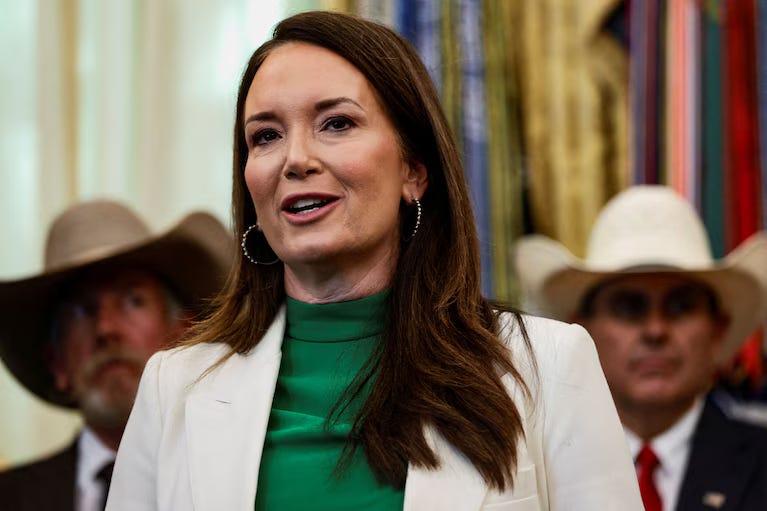
A federal judge ruled Thursday that Agriculture Secretary Brooke Rollins violated the Constitution by sending religious messages to USDA employees through official channels. Judge Trina L. Thompson said Rollins’s emails breached the First Amendment’s Establishment Clause and USDA rules. She emphasized that officials in positions of authority must recognize boundaries when communicating religious messages.
The case centered on messages including a lengthy Easter email sent to about 100,000 department employees. “Happy Easter — He is Risen indeed!” Rollins wrote, describing the holiday as “the greatest story ever told, the foundation of our faith, and the abiding hope of all mankind.” The Washington Post reported in April that some employees were unnerved by the message, which continued with detailed references to Jesus’s resurrection and Christian faith.
The lawsuit was brought by a labor union and six USDA employees. The judge cited Rollins’s authority as secretary, her use of official email, and language that could alienate employees who did not share her beliefs. The Post’s earlier reporting described concerns among staff and legal experts that such explicit religious language from a government leader blurred the boundary between personal faith and official communication.
In April, a USDA spokesperson defended Rollins’s right to send a holiday message, saying past agriculture secretaries and presidents had done so. The department has now called the judge’s ruling an “unprecedented attempt to muzzle a Cabinet Secretary.” The dispute comes amid broader debate over religious expression in federal workplaces and the responsibility of government leaders to serve employees of many faiths—or none.
Editor: A Cabinet secretary has plenty of ways to celebrate Easter. Making the whole department an audience for the sermon apparently wasn’t one of them.
Source: The Washington Post | Earlier coverage
Epstein chased Russian connections for access, status and opportunity—a familiar playbook for men who see the Kremlin as a shortcut to the room where power sits.
Epstein’s Russia Fixation Echoes Trump’s—With Important Limits

Jeffrey Epstein’s interest in Russia grew from a predatory search for young women into an effort to cultivate oligarchs and Russian officials, Reuters reports. He sought introductions to wealthy business figures and senior Kremlin contacts, and tried repeatedly to arrange a meeting with Vladimir Putin. Reuters found no evidence he worked for Russian intelligence, acted for the Russian government, or ever met Putin.
The comparison to Donald Trump is clearest in their shared attraction to Russia’s powerful figures and the status they might confer. Epstein pitched himself as a financial expert who could help wealthy Russians, while pursuing access to oligarchs and Kremlin officials. Trump, meanwhile, was part of Epstein’s wider social orbit, and Reuters reports that he and Epstein overlapped in beauty-pageant circles. That points to a resemblance in elite networking and the pursuit of access; it does not establish that they had the same Russia-related motives.
Epstein’s Russia connections also involved the exploitation of women and girls. Reuters identified at least 17 women from the former Soviet Union drawn into his trafficking network, with modeling agencies and promises of opportunity serving as a pipeline. The report says those ties were central to Epstein’s predatory operation—not simply a way to meet influential men.
After his 2008 conviction for prostitution-related charges, including soliciting an underage girl, Epstein increasingly treated Russian connections as a route back into elite society. He cultivated relationships with figures including real-estate tycoon Vladislav Doronin and former Russian deputy economy minister Sergey Belyakov. He also tried through intermediaries to reach Putin, but the meeting appears never to have happened, and Reuters found no evidence Epstein gained significant influence or business in Russia.
So “for all the same reasons” goes too far based on this reporting. The article supports a narrower parallel: both men pursued proximity to Russian power and the prestige that might come with it. But Epstein’s documented Russia story is inseparable from trafficking and abuse, while Reuters does not establish that Trump shared those motives—or that the two men’s Russia ties were equivalent.
Editor: There’s a real echo in the pursuit of powerful Russian contacts. The evidence doesn’t make the whole song the same.
Source: Reuters
The cyber director is gone after a week of outages—but in Washington, the argument over whether he quit or got fired may be the cleanest system still running.
Cyber Director Sean Cairncross Departs After Tech Outages
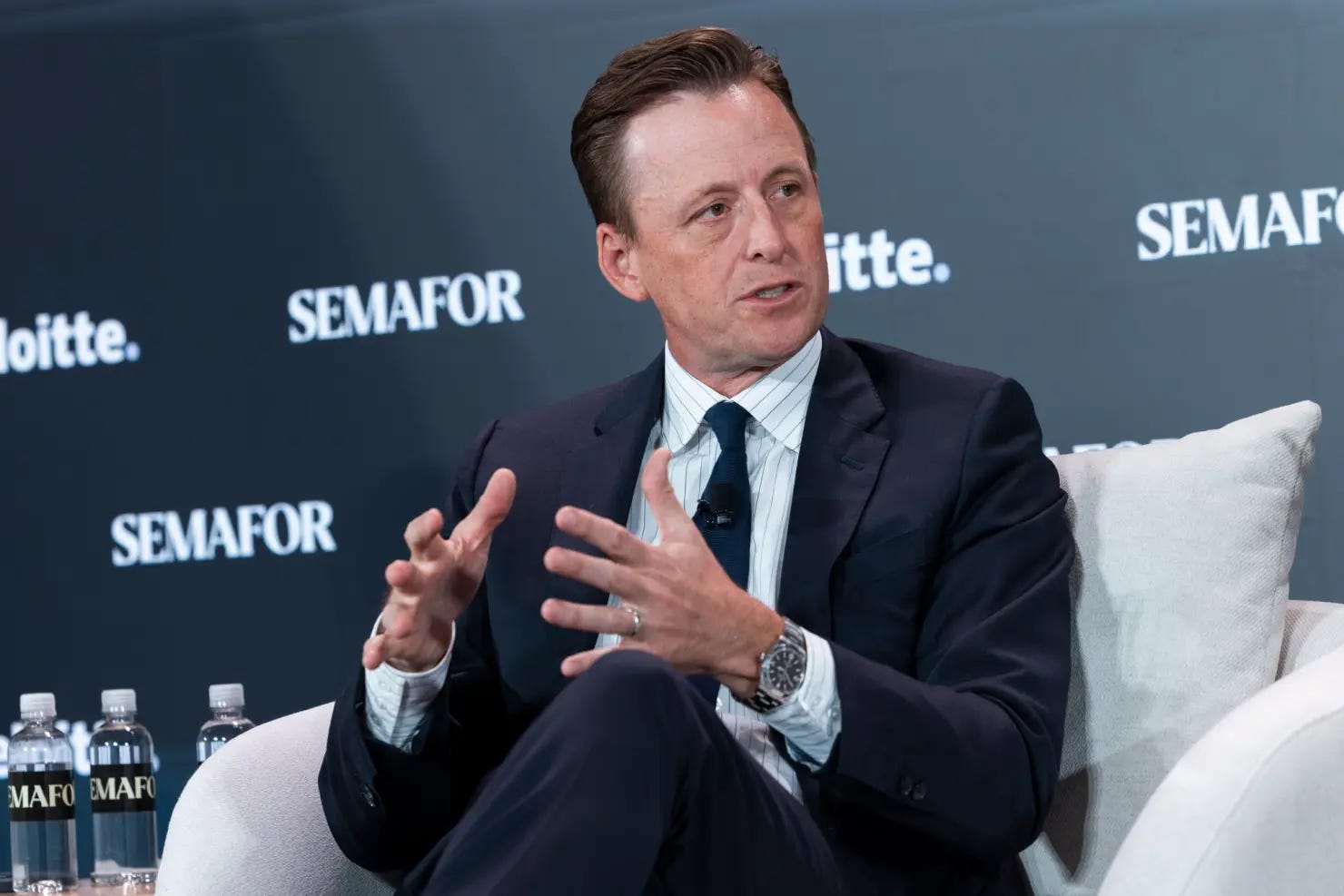
Sean Cairncross, the White House national cyber director, has left his post and will be replaced by Pentagon Chief Information Officer Kirsten Davies, according to Semafor. His departure follows a string of disruptive technology outages that raised concerns about cybersecurity and exposed vulnerabilities in digital systems. The circumstances are disputed: some officials told Semafor Cairncross was fired, while others said he resigned voluntarily.
One White House official and a person familiar with the matter said Chief of Staff Stephen Miller made finding a new cyber director one of his first priorities in the role, and that President Trump supported Cairncross’s removal. Other senior sources rejected that account, saying Cairncross resigned and was not asked to leave. A source who said he was fired argued the recent events showed the need for someone with greater technical expertise.
Semafor’s Ashley Gold noted Cairncross had already been criticized in Washington as unqualified for a cybersecurity leadership role, in part because his prior experience included working as a lawyer for the Republican National Committee. Rumors of a possible ouster dated back to the spring, though Cairncross helped shape the administration’s June executive order on AI and cybersecurity, including voluntary pre-release testing for advanced models. The recent outages may have given his critics an opening.
The outages have affected a range of services, including FAA systems, Microsoft Outlook, JPMorgan services, and the NSA’s internal communications network. The administration has attributed the problems to companies rushing to patch older software after AI tools exposed vulnerabilities; experts quoted by Semafor said that explanation is plausible. At the same time, the incidents have fueled concern that further digital disruptions—and potentially AI-enabled attacks—could bring greater instability.
Davies now takes on the task of building public confidence in the government’s ability to respond to cyber threats. Cairncross told Semafor earlier in the week that the administration expected to make the June executive order’s implementation clearer, and said his office was willing to engage with companies preparing for the current cybersecurity challenges. His departure leaves that work—and the question of how much responsibility the government should take—as urgent as ever.
Editor: When the outages hit the FAA, banks, and government networks, Washington’s first patch appears to have been replacing the cyber director.
Source: Semafor
The South Carolina road-rage case has widened: two officers now face charges over what happened after a fatal shooting, and the recorded evidence is hard to shrug off.
Two Officers Charged In South Carolina Road-Rage Shooting Case
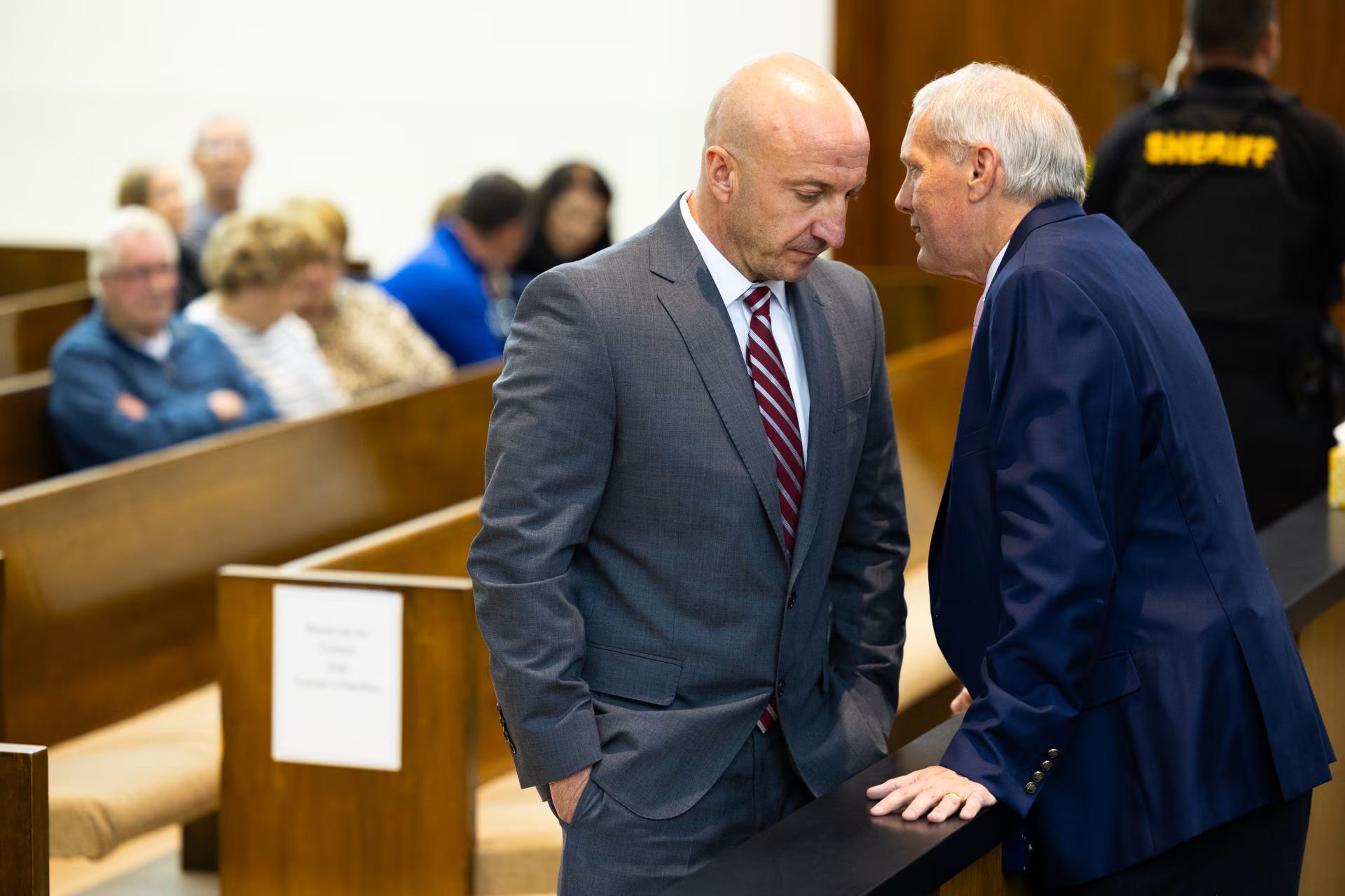
Two former South Carolina police officers were charged Thursday with misconduct and obstruction of justice in the aftermath of a 2023 road-rage shooting that killed Scott Spivey. Former Horry County Deputy Chief Brandon Strickland also faces a conspiracy charge. The charges came a day after Weldon Boyd and Bradley Williams were formally charged with murder and a related firearms offense; Boyd also faces conspiracy charges.
The case has tested South Carolina’s “stand your ground” law, which allows people to defend themselves against a lethal threat. Boyd and Williams initially avoided arrest by claiming they feared for their lives when they shot Spivey. Earlier this year, however, a judge rejected their self-defense claim in a wrongful-death lawsuit brought by Spivey’s sister, Jennifer Foley.
A Wall Street Journal investigation helped bring the case to wider attention by uncovering recordings from Boyd’s phone that were included in police files but had not previously been made public. Some calls suggested Boyd intended to pursue Spivey and anticipated a shootout. In one recording, Boyd told Williams, “I had a f—ing blast.”
The recordings also captured the officers’ alleged conduct. Boyd called Strickland, a longtime friend, minutes after the shooting and asked for help; Strickland later told him, “You’re taken care of.” Vescovi, who arrived at the scene as a patrol sergeant, allegedly wrote a note and held it up for Boyd: “ACT LIKE A VICTIM. Camera.”
All four defendants pleaded not guilty through their lawyers, who argued they had strong community ties and were not flight risks. A judge set bond at $10,000 each for Strickland and Vescovi, $110,000 for Boyd and $100,000 for Williams. Foley asked the judge to deny bond for the shooters and called the former officers’ actions a betrayal of public trust; the defense said it wants a trial, potentially next year, so jurors can hear the full case.
Editor: “Act like a victim. Camera.” is the sort of alleged police advice that makes the phrase “public trust” sound painfully literal.
Source: The Wall Street Journal
Read The Morning Sixpack Archives here:


