



The Morning Sixpack stays free because the news that shapes your life should not be hidden behind a paywall. Paid subscribers are not paying for access. They are helping fund the research, writing, and independent voice that goes into every issue. Become a paid subscriber and help keep smart, honest news analysis free for everyone.
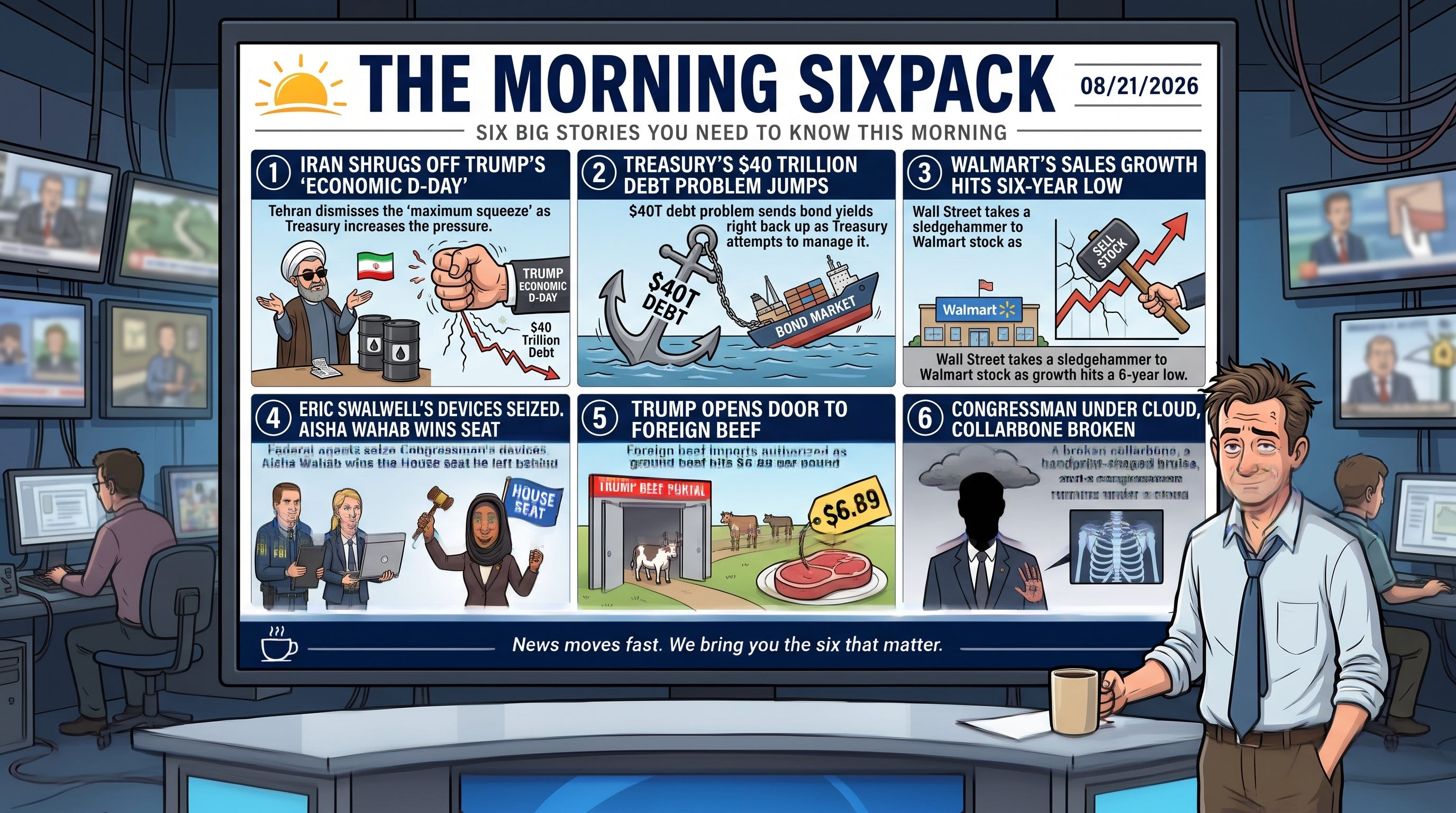
Welcome to The Morning Sixpack Podcast, where today’s menu includes economic warfare, a bond market refusing to take Washington’s hints, Walmart getting punished for making only a mountain of money, an FBI seizure, expensive hamburgers, and one congressional investigation nobody wants anywhere near the family group chat. Apparently August decided it wasn’t going quietly.
Trump is threatening Iran with what he calls the most crushing economic operation ever imposed on a country, and Tehran’s response amounts to: Haven’t we done this already? Iranian officials argue decades of sanctions have failed to break the regime, while Treasury Secretary Scott Bessent is threatening secondary sanctions against countries that continue providing Iran an economic lifeline. That puts a rather large spotlight on China, which Bessent said has been buying roughly 90% of Iranian oil. The administration promises details Monday on its “economic D-Day,” while Iran insists it can absorb more pain. The real test may be whether Washington can persuade—or economically force—the rest of the world to play along. NPR
Treasury tried to push long-term interest rates down with bigger bond buybacks, and the bond market promptly pushed back. The 10-year Treasury yield climbed to 4.704% Thursday and the 30-year reached 5.248%, wiping out the initial relief following Treasury’s announcement that it would at least double longer-term debt buybacks. The backdrop isn’t exactly soothing: federal debt has crossed $40 trillion, inflation remains above the Fed’s target, and massive corporate borrowing for the AI build-out is competing for investors’ money. Washington can intervene in the market, but apparently the market still gets a vote. CNBC
Walmart reported its weakest U.S. comparable-sales growth in more than six years, and investors responded by knocking 9.2% off the stock. U.S. comparable sales increased just 2.6%, but there’s a fascinating transformation underneath that disappointing headline: e-commerce sales jumped 24%, online business now represents nearly a quarter of Walmart sales, and 80% of those digital orders are fulfilled through stores. Walmart also raised its full-year outlook after generating $186.1 billion in quarterly sales. So, yes, Walmart is still enormous. Wall Street simply wanted enormous with better numbers. The Wall Street Journal
Former Rep. Eric Swalwell’s political downfall accelerated as the FBI seized his electronic devices and searched his Washington home—and voters simultaneously chose the woman who will replace him in Congress. Swalwell faces multiple sexual-misconduct allegations, which he denies, and investigations by federal and local authorities. His attorney has called the accusations fabricated and politically motivated. Meanwhile, Democrat Aisha Wahab won the special election to finish Swalwell’s House term and will face fellow Democrat Melissa Hernandez again in November. The allegations remain allegations, but politically the transition has already happened. BBC News NOTUS
Ground beef hit $6.89 a pound in July, so President Trump is temporarily opening the door to substantially more foreign beef without the higher tariffs. Trump says as much as 300,000 metric tons of imported ground beef can enter under the 90-day plan, with a commitment that it will sell 25% below current market prices. America began the year with its smallest cattle herd since the 1950s, and rebuilding those herds could take about two years. Which leaves Washington confronting an inconvenient economic reality: tariffs can be changed with a presidential directive; cows take considerably longer. The Wall Street Journal
Finally, investigators spent months trying to determine how Republican Rep. Max Miller’s 2-year-old daughter suffered a broken collarbone and an apparent handprint-shaped bruise, but the case ended without anyone being charged. County investigators found the abuse allegation against Miller unsubstantiated and said there was no evidence supporting it, while classifying possible abuse as “indicated” against an unidentified alleged perpetrator. Prosecutors ultimately found insufficient admissible evidence to take the case to a grand jury. Miller denies separate allegations made by his ex-wife, but the controversy has triggered a House ethics investigation and injected uncertainty into his reelection campaign. The police file says “Case Closed.” Politics rarely respects police-file endings. The Washington Post
That’s your Morning Sixpack: Iran daring Washington to squeeze harder, investors daring Treasury to fix $40 trillion worth of arithmetic, Walmart discovering $186 billion doesn’t impress everybody, two congressional careers moving in very different directions, and Washington discovering that affordable hamburger apparently qualifies as economic policy. We’ll see what next week manages to break.
Prefer to read The Morning Sixpack? Do that here:


